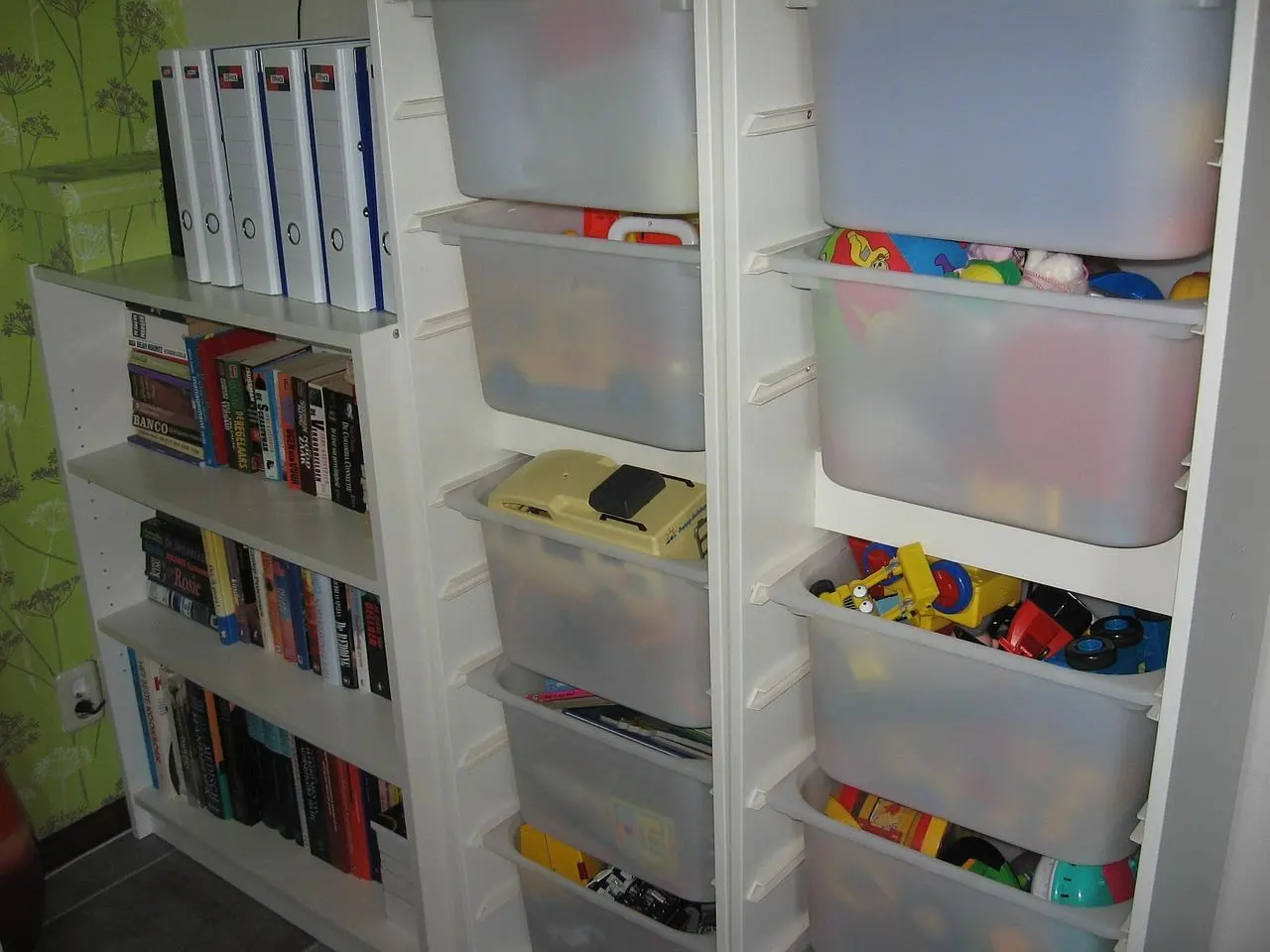
Toys everywhere and a floor you can’t see? Here’s how to organize kids toys: keep a small group out on a low shelf, store the rest by type, and swap them in on a steady rhythm.
This guide sits inside the home organization guide, which covers the rest of the house room by room.
| Key fact | Value |
|---|---|
| Toys offered to the smaller group in a play study | 4 toys (compared with 16 toys) |
| Average toys at home for the families in that study | 90 different toys |
| Items to set out on a low shelf | 9 to 12 different items |
| Suggested rotation pace | No more than once a week |
| Gap between storage-cupboard shelves | 15 cm |
These figures come from Lovevery’s blog and The Montessori Notebook. They are one educator’s or one study’s numbers and can change, so check the sources before you rely on them.
Why fewer toys out works better
The clearest case for fewer toys is a study described on Lovevery’s blog that compared how children played when offered 4 toys versus 16 toys in a room. Toddlers with 4 toys engaged more meaningfully with each one and spent more time exploring. The same post says the parents in that study had 90 different toys at home on average. Read the post here.
You do not have to get rid of anything to get these results. The post’s advice is to put some toys away and bring others out, which can also be a good moment to donate what nobody touches. Lovevery’s blog frames this as keeping toys fresh rather than owning less.
An educator writing for Guidecraft describes the other side of the problem: too many toys at once leads to bin dumping, shallow play and trouble starting play at all. Fewer items out also means less mess and faster cleanup, in that author’s experience. The full piece is on Guidecraft’s blog.
Sort and store toys by type
Before you buy a single bin, sort. The author of The Montessori Notebook found that keeping similar things together, or grouping by age, was the most effective way to store toys. That storage post gives examples: puzzles stacked neatly on one shelf, and musical instruments in a couple of shoe boxes.
A simple order of work looks like this:
- Pull every toy into one place so you can see what you really have.
- Group by type: puzzles, building toys, vehicles, instruments, art supplies, books.
- Set aside broken toys and the ones nobody plays with.
- Decide which groups stay out and which go into storage.
If the room feels too full to even begin, the steps in how to declutter a room step by step will help you clear floor space first.
How often should you rotate toys?
The sources agree on a gentle pace. Lovevery’s blog suggests rotating no more than once a week, and potentially only every few weeks, with some favourites staying out for a year or more. That advice is aimed at toddlers.
The Guidecraft educator rotates every 1-2 weeks, depending on how much time the family spends at home. The Montessori Notebook’s author swapped materials once a week when the children were toddlers, keeping what was used often and adding a few new things. See Guidecraft and The Montessori Notebook.
Watch the play before you swap. According to The Montessori Notebook, a toy that is being thrown is often too easy or too hard, which makes it a good one to put away.
A simple recipe for each rotation
Guidecraft’s system uses 7-10 items per rotation and covers seven categories, so the shelf offers variety. The post was designed for children from 10 months to 7 years, and the categories are:
- Solve: puzzles and other toys with one clear outcome.
- Build or create: blocks and other open-ended building toys.
- Push or pull: cars, trucks, wagons, trains or carts.
- Music or sensorial: instruments, play silks, mirrors, sensory bottles.
- Text connection: a book paired with a toy that links to it.
- Task-based: peg boards, lacing toys, drawing boards.
- Discovery: a wild card such as a basket of household items.
Older children can help with the swap. The Montessori Notebook suggests asking what they would like to put away if they want something to come out of storage.
Set up the play shelf for easy cleanup
Lovevery’s blog recommends arranging around 9 to 12 different items on a low shelf, so your child can choose one to focus on. Everything else goes in a closet or somewhere out of reach and out of view. Leave space between items so each one is easy to see, as the Lovevery post describes.
Use baskets for small related pieces. They keep sets together and let a toddler practise putting things in and taking them out. Guidecraft adds that shallow, light baskets let a child carry a set down from the shelf to start playing.
Offer puzzles undone. As the Guidecraft educator puts it, a finished puzzle gives little motivation to complete it, while an undone one invites play without intimidating a child. The same idea applies to a stacker with its rings loose in a basket.
Lego can follow the same logic. The Montessori Notebook describes one box of mixed Lego for free building, plus one instruction set out at a time that is swapped when it stops being used. The idea keeps a sprawling collection manageable.
Store the rest out of sight and in order
The Montessori Notebook’s author sums up a working storage setup in one principle: there is a place for everything and everything is in its place. These are the practical tips from the storage post:
- Fit plenty of shelves, spaced about 15 cm apart, so puzzles stack neatly instead of towering.
- Label boxes, because a mystery box rarely gets opened again and labels let other caregivers help.
- Use small bags for individual sets of activities, reusing old zip-lock bags.
- Clear out what is no longer used when the storage is full.
Once the playroom works, carry the same place-for-everything idea to the front door with how to organize an entryway, where shoes, bags and outdoor gear tend to pile up.
Frequently asked questions
Do I have to throw toys away to get organized?
Show answer
Not necessarily, because rotation mostly means moving toys into storage. If the cupboard fills up, though, The Montessori Notebook advises clearing out what is no longer used instead of squeezing in one more item, and passing those toys to other families.
What if my child dumps every bin on the floor?
Show answer
Tipping out bins often points to an overloaded shelf. The educator on Guidecraft’s blog recommends storing most toys and offering a small selection, with small pieces in shallow baskets that are easy to carry.
Will swapping toys upset my toddler?
Show answer
It can if everything changes at once. The Montessori Notebook notes that toddlers have a strong sense of order, so change only a few things at a time. Lovevery’s blog suggests making the swap while your child is not around and leaving favourites in their usual place.
Can an old, “too easy” toy come back out?
Show answer
Yes. Lovevery’s blog points out that toddlers learn through repetition and may return to toys that look too easy to an adult. Watch how your child plays with it over the next few weeks before deciding whether to put it away again. See the full post.